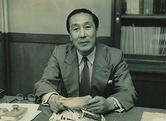
Kazuhiko Asai, Ph.D., was the founder of the Asai Germanium Research Institute and the creator of Asaigermanium. In the turbulent years following World War II in Japan, he pursued his work with steadfast conviction and passion, making major contributions to Japan’s coal industry and to scientific progress.
Here is the history of Dr. Kazuhiko Asai.
| 1908 | He was born on March 30 in Northeast China. He returned to Japan at around the age of 10 and lived in Tokyo. |
| 1932 | He graduated from the Faculty of Law at Tokyo Imperial University (now the University of Tokyo). He worked hard to become a diplomat and passed the diplomat service exam. In the spring, he joined the Okura Group and entered Okura Trading Co., Ltd. |
| 1934 | He was dispatched to Berlin as the Okura Trading representative in Germany. |
| 1936 | In November, he married his secretary, Erika Helterhoff. In Berlin, he had acquaintances at the Japanese Embassy, including fellow alumni of the University of Tokyo; nevertheless, he was not at ease mentally and suffered a nervous breakdown. A young German friend of his took him to a coal mine to help him recover, and he was profoundly struck by the sight of people working deep underground, battling nature. Thus he realized, “This is the path I am meant to follow,” and resolved to change his life completely and devote himself to coal research. |
| 1939 | He enrolled at Technische Universität Berlin (TU Berlin) to pursue for coal research. |
| 1943 | He graduated from TU Berlin. |
| 1945 | Just before the end of the war, he narrowly escaped death and returned to Japan. He established the Coal Research Institute, an incorporated foundation, to support Japan’s postwar reconstruction. Around this time, John Bardeen and his colleagues at Bell Laboratories in the United States invented the world’s first successful transistor by exploiting the semiconducting properties of germanium. (This achievement was later recognized with the 1956 Nobel Prize in Physics, drawing global attention to the semiconducting properties of germanium.) Asai learned that Japanese coal contains substantial amounts of germanium and began exploring methods to extract it. |
| 1952 | He succeeded in extracting germanium dioxide from the spent gas liquor generated during the dry distillation of coal. |
| 1953 | He successfully produced ultra-high-purity polycrystalline germanium (an ingot of elemental germanium) from germanium dioxide. Asai reasoned that the original plant, which were later transformed into coal, must have absorbed germanium for some purpose while they were still alive. To elucidate the relationship between plants and germanium, he analyzed the germanium content of fast-growing bamboo and dwarf bamboo (sasa) and confirmed that several sasa species contained relatively high levels of germanium. |
| 1957 | In recognition of his inventions and contributions to the development of new technologies, he was awarded the Medal with Purple Ribbon by the Prime Minister of Japan. |
| 1959 | In animal experiments using a fructose solution of germanium dioxide, effects on radiation damage were observed; however, germanium dioxide was also found to accumulate in the bone marrow, spleen, kidneys and other organs. He therefore concluded that a highly safe organogermanium compound would be necessary for incorporation into living organisms. |
| 1961 | He obtained a doctorate in engineering from Kyoto University. |
| 1967 | He succeeded in synthesizing a water-soluble organogermanium compound for health care ahead of the rest of the world. By this time, after years of physical exhaustion and mental stress, he had become bedridden with systemic rheumatoid arthritis, gout, and other ailments. Nevertheless, without the slightest doubt, he drank the finished aqueous solution of his first organogermanium compound. He found that it caused no toxicity, side effects, or adverse reactions in his own body, and after 10 days, he had recovered sufficiently to walk. |
| 1968 | He established the Asai Germanium Research Institute (an individual research laboratory) and presented his work at the Chemical Society of Japan. |
| 1975 | In February, he was recommended for a full member of the New York Academy of Sciences. In September, his book Germanium and I was published. In the book, he advocated the “oxygen substitution theory,” proposing that germanium enriches oxygen in the body. He was also invited to the World Congress of Natural Medicine held in France, where he delivered a lecture on organogermanium and drew widespread attention. He also established Asai Germanium Research Institute Co., Ltd. |
| 1976 1977 |
He lectured at the Congress of Natural Medicine held in Switzerland (1976) and Italy (1977), attracting further attention. |
| 1978 | He published his second book, Germanium Hymn. |
| 1979 | In June, the first Germanium Research Meeting was held. Full-scale research into the bioactivity of organogermanium began, involving researchers from universities and research institutes across Japan. |
| 1981 | He published his third book, Germanium and My Life. |
| 1982 | On October 22, he passed away at the age of 74, entrusting his work to the next generation with the wish that “I want my germanium to be useful for people’s health.” |